
How to Search Criminal Dockets
Start at Georgia Courts E-Access to Court Records. It is the official entry point for a Clinch Superior criminal search. E-Access works as a provider directory rather than one statewide search box. Choose Clinch Superior. Follow the link to PeachCourt, and set up an account before you attempt the search. Once you pick Clinch County and the Clinch court, PeachCourt help lays out two routes. Those routes are an exact case number or a party name. The narrowest identifier wins. An exact number is far easier to reconcile than a broad name search, and the clerk can supply one if you lack it. Your matter might be a Clinch County warrant, preliminary hearing, municipal citation, Juvenile case, or federal case. Pause before assuming a Superior result fits.
- Open the Georgia Courts E-Access directory and choose Clinch Superior.
- Sign in to PeachCourt or complete the Clinch account registration before using the gated court search.
- Select the correct Clinch County court, then enter the exact case number or search by the party information allowed by the provider.
- Compare the result with the filing year, case type, attorneys, dated entries, and Clinch court class before relying on it.
- If no result appears, ask the Clinch County Clerk of Superior Court whether the Clinch record is in a local, paper, archive, or different-court file.
Viewing a document through Clinch PeachCourt is not the same as holding a certified copy. When you ask the Clinch County clerk for a docket sheet, disposition, sentence, or judgment, name the item you want and give the case number separately.
Clinch County Criminal Docket Classes
Clinch County splits its criminal records across several routes. Felony cases go to Clinch Superior Court. That court holds the main PeachCourt connection. The Magistrate Court handles limited criminal work, including warrants, preliminary hearings, and bail. Traffic and city ordinance matters go to the municipal courts. Juvenile records follow a protected route. Federal matters belong to the Middle District of Georgia, not the Alapaha Judicial Circuit.
The Georgia Courts court guide gives the statewide court-class descriptions, and the Alapaha courts directory points to the Clinch County Superior, Probate, Magistrate, and Juvenile offices. Keeping those sources straight keeps a limited Clinch court record from being mislabeled as a Superior criminal docket.
| Court route | Criminal record focus | First access point |
|---|---|---|
| Clinch Superior Court | Felony cases, indictments or accusations, dispositions, sentences, and appeals | PeachCourt or the Superior Clerk |
| Clinch Magistrate Court | Warrants, preliminary hearings, bail, and limited minor criminal functions | Magistrate office |
| Clinch Juvenile Court | Delinquency and other protected juvenile matters | Juvenile Court clerk |
| Clinch municipal court | City traffic and ordinance matters | Issuing city court or clerk |
| Clinch federal court | Federal cases assigned to the Valdosta Division | PACER or federal clerk |
What a Criminal Docket Shows
Uniform Superior Court Rule 39.3 supplies the model for criminal docket fields, though a public provider display may show only part of it. Get the exact Clinch County case number from the clerk or provider rather than guessing at a pattern. Then read each field with its date and source. A charging instrument states an accusation or indictment. A Clinch plea records a response. A Clinch disposition records the outcome for a count, and a sentence adds punishment, conditions, costs, fines, or restitution. Those are separate events, not one.
| Case number | The unique identifier supplied by the court or provider, such as the exact Clinch case number. Use its exact punctuation and spacing. |
|---|---|
| Filing and defendant fields | Filing date, defendant information, and an OBTS field when applicable. Protected identifiers should not be copied. |
| Counts and charge | Clinch County offense counts plus an indictment, accusation, or citation number when the docket carries one. |
| Plea and jury status | The recorded Clinch County plea, plea date, and jury or non-jury status. |
| Disposition | Clinch count-by-count outcome such as dismissal, nolle prosequi, guilty, not guilty, or another Rule 39.3 category. |
| Sentence and later activity | Clinch sentence date, term, conditions, costs, fines, restitution, warrants, transcript, appeal, remittitur, and minutes or final-record references. |
Clinch County Criminal Filing Trail
For a Clinch County Superior criminal search, keep the unique case number, filing date, charging instrument, defendant, counts, and court together in your notes. The clerk can tell them apart. The Clinch County Clerk of Superior Court distinguishes a docket request from one for an indictment, accusation, plea, sentence, or final record. Ask the provider or clerk for the identifier. The matter may have begun as a Clinch County warrant, preliminary hearing, city citation, Juvenile case, or federal case. The filing trail may belong to a different office entirely. Reconcile any PeachCourt result with the issuing court. Do that before treating it as the complete Clinch criminal record.
Clinch County Criminal Dispositions
The dated Clinch County docket entry is the safest unit for reading a Clinch criminal case. A warrant or accusation is not a conviction. A calendar entry is not a plea. If a later judgment, sentence, dismissal, or appeal changes the posture of the case, that later entry belongs in your account of the Clinch case.
- Indictment or accusation
- A charging document. It identifies the criminal allegation being placed before the court, not the final result.
- Nolle prosequi
- A prosecution-ending entry whose meaning must be reported using the official docket wording and date.
- Disposition
- The recorded outcome for a Clinch County count or case. It is distinct from the original charge and from a later sentence.
- Remittitur
- An appellate return or order that can appear after an appeal and belongs to the later part of the Clinch County docket trail.
When no disposition shows up in the public material, say exactly that. It does not prove the court never entered one. Nor does it prove a provider holds every Clinch County historical document. Rule 39.3 also calls for sentence and cost information. But an online line is not an invoice. Only the judgment, the sentencing record, or the clerk can establish what a particular case requires.
Stages on a Criminal Docket
The Clinch County criminal docket tracks a sequence. That sequence is not a promise. Not every Clinch County case has every event, and the order can vary. A case may begin with a charging document, move through arraignment and pretrial settings, and end with a plea or trial, then a disposition and sentence.
Docket flow: Charge Filed › Arraignment › Pretrial Settings › Plea or Trial › Disposition › Sentencing
The Alapaha calendar may show a label such as Clinch Arraign. or Clinch Criminal. The label alone proves nothing about whether a named defendant appeared or entered a plea. The dated docket entry remains the source for the event.
Clinch County Criminal Warrant Records
Clinch County's Superior Court criminal work runs through the Clerk of Superior Court page. That office files criminal cases and keeps the criminal warrants. Mary Ruth Handley serves as Clerk. Rosa White and Vonda Hendricks hold deputy and court-clerk roles. For a Clinch County Superior criminal docket, a sentence, or any final record, this is where a request starts.
Warrants also come out of the separate Probate and Magistrate Court office. That court handles limited Clinch County criminal matters, preliminary hearings, and bail, except where a matter is reserved elsewhere. No juries sit there. A written jury request can move a qualifying case to Superior Court. Staff will not give legal advice. On any warrant question, name the issuing Clinch court. And remember that an old docket line does not prove a warrant is still active.
Superior Clerk
Mary Ruth Handley
25 Court Square, Suite C
Homerville, GA 31634
912-487-5854
Magistrate office
Limited criminal and warrant route
110 Court Square
Homerville, GA 31634
912-487-2514
Before calling either office, sort out what you actually need. A docket inspection, a plain copy, a certified copy, a transcript, and a warrant record are five different products. Some may sit with different custodians, so the answer shapes where the request goes.
Clinch County Criminal Record Copies
A Clinch County Superior criminal file can hold several distinct pieces. Ask the Clerk of Superior Court what you need. Options include a docket sheet, plain copy, certified copy, judgment, sentence, transcript route, or final record. No certified-copy fee schedule is published for Clinch Superior. Get the amount before you authorize payment.
Give the clerk the case number, the filing year, the party style, and the exact record sought. It helps to ask where the item lives. It could sit in PeachCourt, a local system, paper storage, or a restricted category. The clerk can lay out the in-person, phone, or written request path. A calendar label on its own cannot supply the Clinch record.
Which Court Holds Criminal Dockets
Felony charges in Clinch County run through Superior Court. The Superior Clerk also serves the Juvenile Court. Juvenile access rules are far stricter than public Superior criminal access, though. Magistrate Court covers its limited functions. A city citation belongs to the issuing municipal court, and federal prosecutions belong to the Valdosta Division of the Middle District of Georgia.
Above the trial level, the Court of Appeals of Georgia reviews eligible state trial-court decisions. The Supreme Court of Georgia takes its exclusive constitutional, capital, election, and equity categories. An appeal or remittitur can stretch a Clinch record past its original trial-court entries. It still stays a state docket, never a federal case file.
Clinch County sits in the Alapaha Judicial Circuit. The circuit directory lists Superior, Probate, Magistrate, and Juvenile routes. No separate Clinch State Court page exists among the official local sources. So treat any State Court result for this county with doubt.
Clinch County Juvenile Docket Access
Judge Suzanne P. Mathis presides over the juvenile route described on the Alapaha Juvenile Court page. That page covers Clinch County. Juvenile delinquency records carry strong protection. A Clinch County public calendar may label Clinch DJJ, DFCS, or Child Support settings. But those labels do not open party names or underlying documents to the public.
The official JDEX login notice warns plainly that juvenile information is confidential and access-controlled. It is not a name-search tool for the public. Anyone with lawful access should ask the Juvenile Court clerk about the right permission or court process. Guessing from a calendar entry is not the route.
Clinch County is also served by the Alapaha Circuit's Drug and Mental Health Court. The accountability-court directory offers no separate public specialty docket. Program participation, treatment details, assessments, and compliance records raise their own access questions. None can be inferred from a Clinch County Superior criminal entry. The JDEX notice is posted at the official source for anyone to read before making a juvenile request.
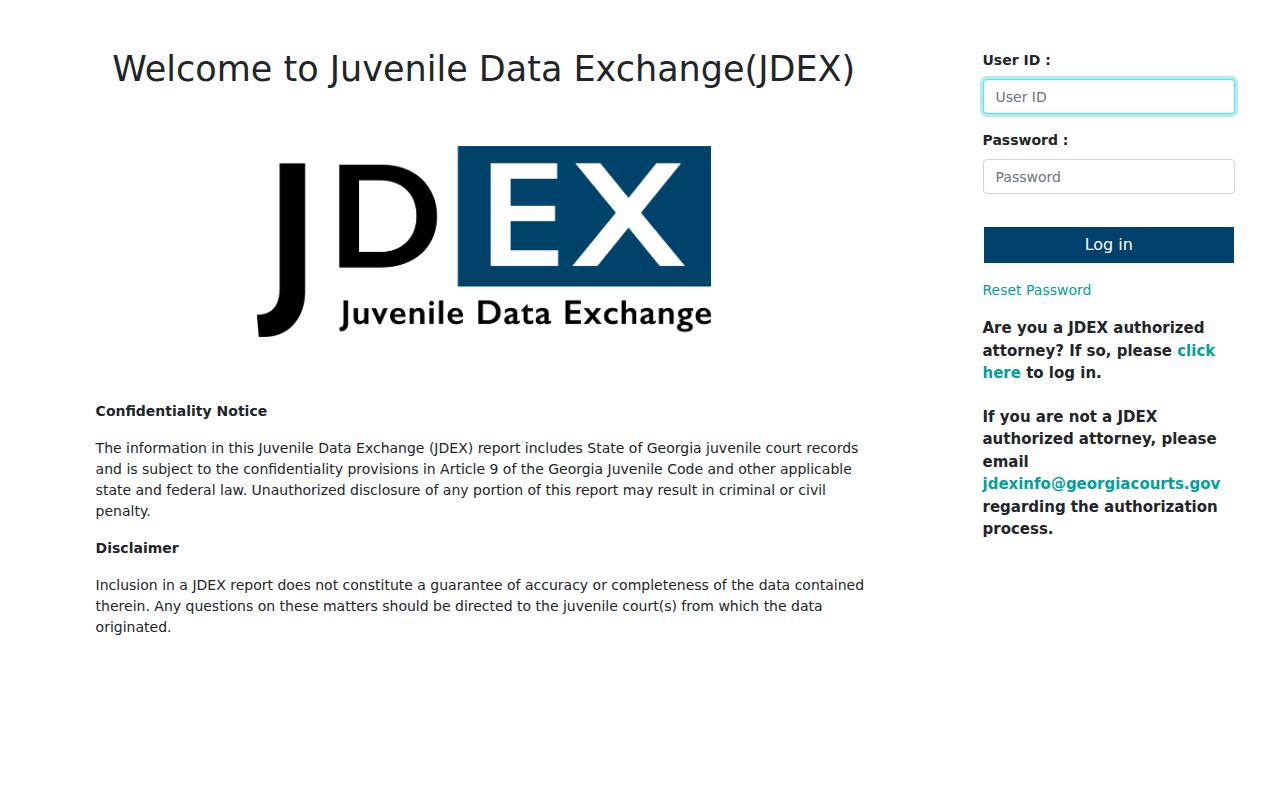
That login notice restates the line a visitor should hold onto: a public calendar category is one thing, and a protected juvenile file is another.
Clinch County Criminal Data Boundary
Analytics tools sit apart from case files. The Criminal Case Data Exchange dashboard can filter by Clinch County or court class. It counts disposition transmissions by OTN, with data refreshing every 60 days. The Georgia Courts data-and-records page links the related statewide systems. CDX is still not a public name search. It is not a certified Clinch County case file either.
The difference matters when a dashboard count, a GBI criminal-history response, and a Clinch County Superior docket entry land in the same project. Each answers to a different office and purpose. For a dated court entry, use the Clinch County Clerk of Superior Court. Reserve the GBI route for the criminal-history restriction question it actually addresses.
Public Access and Sealed Criminal Dockets
Most Clinch County court records are open to anyone. Access shrinks only when a law or a court order limits it. Uniform Superior Court Rule 21 spells out both the public's access and the limits a judge can impose. Redaction duties sit elsewhere in the rules. Rule 36.17 makes filers trim sensitive identifiers down to the permitted partial forms, so a Clinch County public docket may show fields that the filer was never supposed to leave whole. Treat what you see carefully rather than copying every field as safe to repeat.
Some records sit outside the open docket entirely. Juvenile and adoption files carry their own limits under O.C.G.A. §§15-11-708 and 15-11-709 plus the matching court rules. Sealed or in-camera materials, protected child-welfare information, and medical or guardianship material can also be off limits. When a Clinch County court record is missing online, the reason could be a seal, a restriction, no digitization, a provider gap, or another office holding the file.
Key access rules:
Uniform Superior Court Rule 21 generally keeps court records public unless a law or order limits access.
Uniform Superior Court Rule 36.17 limits public filing of Social Security, tax, financial-account, and full birth-date information.
O.C.G.A. §35-3-37 provides a criminal-history restriction route that is separate from changing or deleting a clerk’s court docket.
GBI Restrictions on Clinch County Criminal Dockets
Record restriction works differently from a Clinch County criminal docket search. The two should not be confused. The Georgia Bureau of Investigation runs a criminal-history process that can restrict certain arrest information. For arrests before July 1, 2013, the qualifying routes differ from those after that date. A restriction request also does not mean every Clinch County court record tied to the case has been destroyed or removed.
A Clinch County court docket entry still comes from the court itself. Report the official entry and its date, then send any restriction question to the GBI. That agency source does not stand in for PeachCourt. Nor does it stand in for the Clinch County Superior Clerk, the Juvenile Court clerk, or a municipal court. The GBI restriction form carries the current paperwork and the agency's own steps.
The GBI FAQ explains what a restriction request actually does. Treat it as background, not as a live Clinch criminal docket.
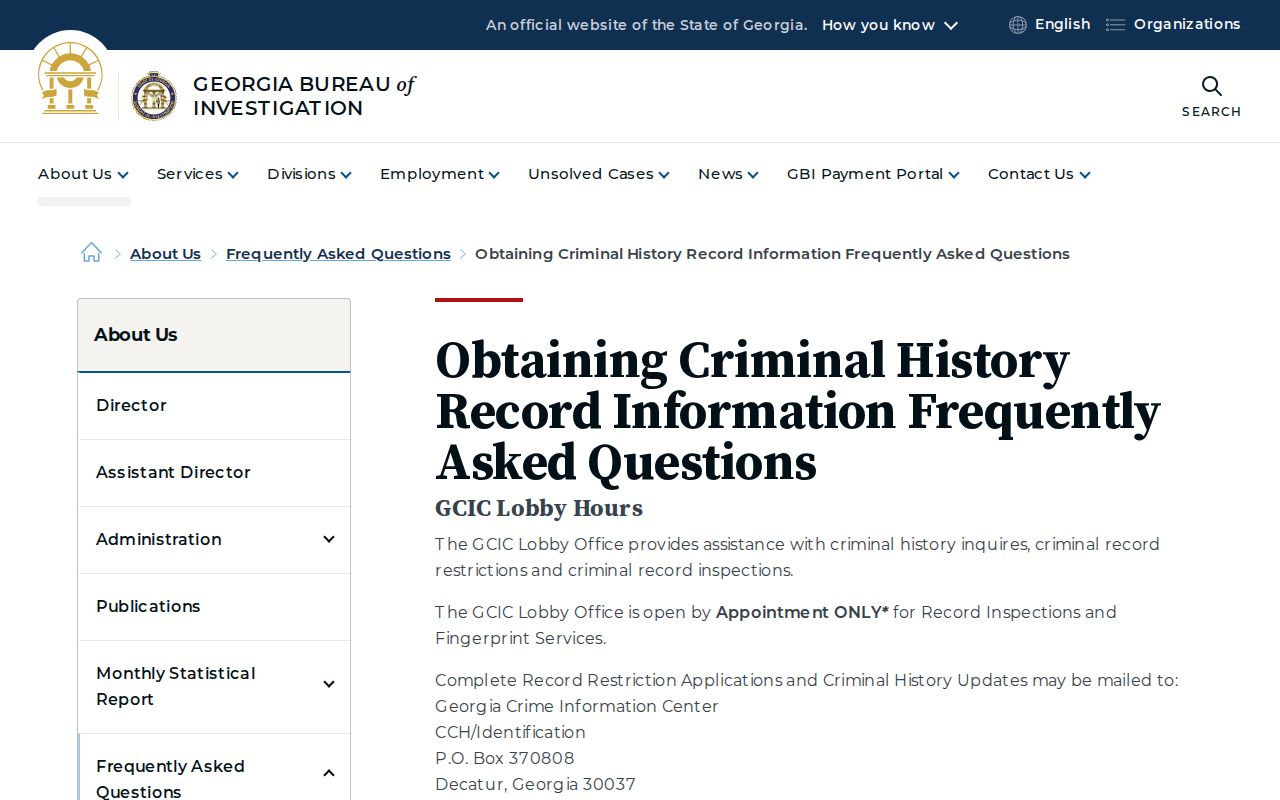
The FAQ draws a clean line between criminal-history information and court records, which keeps a docket entry tied to the clerk who holds it. The GBI restriction page makes the same point another way. A restriction request is an agency process, not a court-docket deletion service.
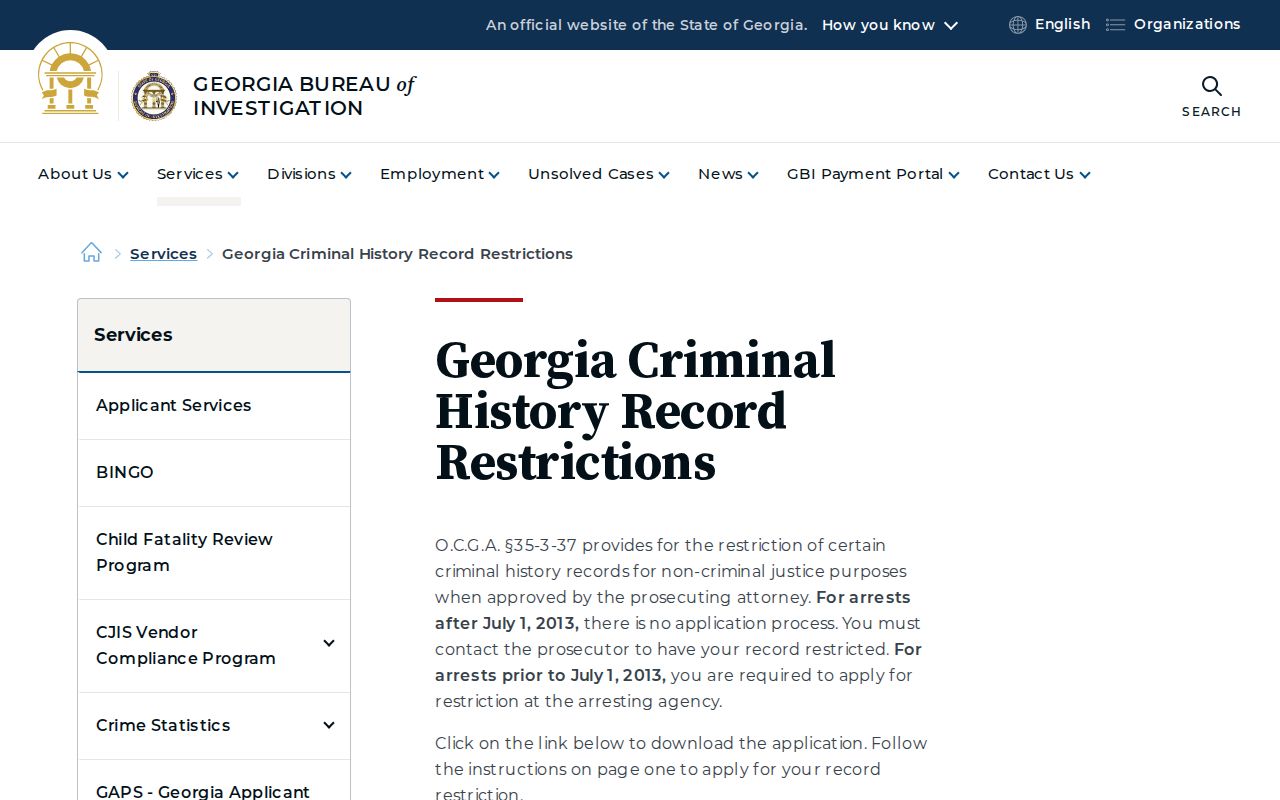
For a disposition, a sentence, or a warrant entry, go back to the named court or clerk. Verify the dated source there.