
How to Get Court Records
First figure out which court keeps the Clinch County record you need. Most people start with the Clinch County Clerk of Superior Court. That office handles Superior Court civil filings, domestic matters, and criminal cases. It also covers the Juvenile clerk duties listed on the county page. Mary Ruth Handley serves as clerk. Rosa White and Vonda Hendricks fill deputy and court-clerk roles. You can reach the office at 25 Court Square, Suite C, Homerville, GA 31634. Call 912-487-5854 or fax 912-487-2316. If no online docket result turns up, mail a written request to the office instead. Ask for the court records by case number.
- Identify the court class, case type, approximate filing year, party or case style, and case number if known. A Clinch city citation, Clinch Probate file, or Magistrate claim should not be sent through the Superior route by default.
- For a Clinch County Superior case, open Georgia Courts E-Access to Court Records and select Clinch Superior. The directory sends the searcher to PeachCourt, where an account is required before the court search.
- Use the Clinch County direct clerk path when the record is not displayed online. Call the Superior clerk, visit the listed office after confirming current service details, or send a narrow written request by mail. State whether the request is for a docket sheet, filed document, disposition, transcript route, plain copy, or certified copy.
- Use the Georgia Open Records Act route for a Clinch County record held by a public custodian that is not available through the provider. An oral request is allowed, but a dated written request gives the custodian a clear description, date range, medium, and delivery preference.
- Review the response before relying on it. A provider display is not a certified copy, a calendar entry is not a judgment, and a missing Clinch County online document may require a paper, archive, sealed-record, or separate-court inquiry.
A quick calendar check can pin down a court date before you call the clerk. The Alapaha Judicial Circuit calendar index posts monthly calendars. It also carries annual schedules, weekly hearing lists, calendar calls, and civil trial settings. Just know their limits. These public calendars do not offer a party-level case search. The circuit office sits at 201 N. Davis Street, Room 261, Nashville, GA 31639. The phone is 229-686-2180. A federal case in Clinch County belongs with the Middle District of Georgia Valdosta Division, not a Georgia state clerk. Once you have the case number, a focused Clinch County case search can point you to the right record. That saves time before you request copies.
Clinch County Record Channels
Clinch County splits its court records across several offices. The state E-Access page works as a directory rather than one free-text index, and its Clinch County Superior link leads to a provider behind an account wall. Probate, Magistrate, Juvenile, and municipal records each sit with separate Clinch County offices. The matrix below gives the best first route for each record family and notes the limit you may hit along the way.
| Record family | Likely custodian | Access route | Known limit |
|---|---|---|---|
| Clinch County Superior civil or criminal | Clerk of Superior Court and PeachCourt | E-Access, then PeachCourt; clerk counter, phone, or written request | Account required; not every document is online |
| Clinch County Probate estate or license | Clinch County Probate Court | Probate office at 110 Court Square or its published phone line | No public county case-search form located |
| Clinch County Magistrate claim or dispossessory | Clinch County Magistrate Court | Magistrate office at 110 Court Square or 912-487-2514 | No public case-search form or copy schedule located |
| Clinch County Juvenile material | Clinch County Juvenile Court clerk and authorized systems | Ask the clerk about lawful access | JDEX and juvenile confidentiality limits apply |
| Clinch County federal case | Middle District Valdosta clerk | PACER or CM/ECF and the Valdosta Division | Separate federal system and account route |
The matrix also guards against a common routing mistake. A Clinch County Superior Court search can surface a divorce, felony case, or civil filing. It will not find a will. Nor will it find a small claim, a city ordinance matter, or a Clinch County federal action. The court named on the document decides your next call. For wills and small claims, that often means the Clinch County Probate and Magistrate Court office. It sits at 110 Court Square. Federal matters go to the Valdosta clerk at 401 North Patterson Street, Valdosta, GA 31601. The phone is 229-242-3616, open 8:30 a.m. to 5:00 p.m., with email at valdosta.ecf@gamd.uscourts.gov.
Note: Clinch County did not publish a single Clinch-wide case-number search page outside the PeachCourt provider directory.
Clinch County Court Record Archive
PeachCourt's own help pages say some courts have docket material going back to 2005. Clinch County's exact online start date is another matter. The clerk does not publish one. So treat 2005 as a maybe rather than a promise. Plenty of older Clinch material still lives outside any provider system. That includes paper filings, exhibits, minute books, proposed orders, sealed items, and anything a vendor simply chose not to buy.
So an empty PeachCourt result does not mean the Clinch County case never existed. Before you give up, ask the Clinch Superior Clerk directly. The filing could sit in PeachCourt, a local system, plain paper storage, or a restricted category. The clerk can tell you which.
Types of Court Records
A docket line is only the start of what the Clinch County clerk keeps. The Clinch Clerk of Superior Court page lists court records and public court records. It also covers real-estate instruments, military discharges, Fi. Fas., fines, child support, property-transfer taxes, criminal cases and warrants, and civil filings. Notary and jury functions appear there too. So does the Clinch County Juvenile Court clerk role.
Each category carries its own access and privacy rules. That matters for how you ask. A Clinch County request should name the specific item you want. Do not just request every record the office holds.
- Clinch County Superior civil and domestic filings, including divorce, annulment, adoption, name-change, and garnishment matters.
- Clinch County criminal case records, charging documents, warrants maintained or filed by the clerk, dispositions, sentences, and related docket entries.
- Clinch County real-estate instruments, military discharges, Fi. Fas., fines, child-support records, and property-transfer tax records identified by the clerk.
- Clinch County Juvenile clerk records, which require a separate access review because juvenile information is not generally open for a public name search.
- Clinch County Probate records such as wills, estates, guardianships, involuntary-hospitalization files, marriage and firearm licenses, and vital-record services.
- Clinch County Magistrate files for small claims under $15,000, dispossessory writs, warrants, preliminary hearings, bail, and good-behavior matters.
Clinch County Probate and Magistrate both sit at 110 Court Square. Their records are not just branches of the Superior clerk's files, though. Call Probate at 912-487-5523. Call Magistrate at 912-487-2514. A city ordinance violation or traffic citation belongs with the municipal court. It belongs with the city clerk that issued it, too. Whatever the record, name the Clinch County record category. Put the court class in the first sentence of your request.
Clinch County Clerk Court Records
Mary Ruth Handley serves as Clerk of Superior Court for Clinch County. Per the Clinch County clerk page, the clerk is elected to a four-year term. The clerk also maintains the court records. Rosa White is Deputy Superior Court Clerk, and Vonda Hendricks is Court Clerk. Knowing these names helps you address a Clinch County request to the right office. Still, describe the record and court class you need. Do not assume one staff member holds every file.
Clerk of Superior Court, Clinch County
Clinch County Superior Court records office
Mary Ruth Handley, Clerk
Rosa White, Deputy Clerk
Vonda Hendricks, Court Clerk
25 Court Square, Suite C
Homerville, GA 31634
912-487-5854
Fax 912-487-2316
Official Clinch County clerk record inventory
What does the Clinch County clerk actually do? The office files civil and criminal cases, keeps criminal warrants, collects fines and child support, records property-transfer taxes, and handles notary and jury services. That is a wide portfolio. It covers routing a visitor toward the right record, but it does not promise that every file is digitized or that any copy can go out the same day. So be specific when you call. Ask the Clinch County clerk for the exact product you need: docket inspection, a filed pleading, a final judgment, a sentence, a certified copy, a transcript procedure, or a referral somewhere else. Wills, estates, guardianships, small claims, dispossessory actions, and municipal citations sit with separate offices. Skip the trip that asks the Superior clerk to rebuild another court's file.
Clinch County Clerk Copy Route
The Clinch Superior Clerk lists its route as 25 Court Square, Suite C, Homerville. Phone 912-487-5854. Fax 912-487-2316. The clerk posts no current local certified-copy fee schedule. So expect to ask about charges directly. Say up front what you want: inspection, a plain copy, certification, a judgment, a sentence, a transcript procedure, or a filed document. Naming the product helps the office identify it fast. Give the exact Clinch case number or legal case style whenever you have it. If the file is not online, ask whether a phone, counter, mail, or written-record request fits. Also ask whether another court or custodian holds the item instead.
What a Court Record Contains
An online result is only a sliver of a Clinch County court record. The full file runs much deeper. Uniform Superior Court Rules 39.2 and 39.3 lay out the civil and criminal docket fields. Those fields help you name the part of the file you need. No exact Clinch County case-number example is posted. So copy the punctuation and spacing the clerk or PeachCourt supplies. A model field list can still shape a precise request. Just do not invent a local case number to fill it in.
| Case or action number | The unique Clinch County civil or criminal identifier. Civil numbering can use filing year, case type, consecutive number, and judge assignment where required, but the local example must come from the custodian. |
|---|---|
| Parties and attorneys | Clinch County names, legal style, attorneys, and the party relationships needed to distinguish similar matters. |
| Filing and service | Clinch County filing date, action type, pleadings, service date and method, advance or additional costs, and the documents entered at the start of the case. |
| Docket entries | A chronological Clinch County record of complaints, indictments, accusations, motions, orders, pleas, hearings, judgments, sentences, dismissals, and other filed events. |
| Disposition and judgment | The recorded Clinch County outcome, disposition date and type, judgment category, prevailing party where applicable, settlement, dismissal, or final order. |
| Enforcement and sentence | For a Clinch County civil matter, a Fi. Fa. date may appear. For a criminal matter, the rule-based fields can include sentence type, term, conditions, costs, fines, restitution, and warrant returns. |
| Appeal and storage trail | Notice of appeal, remittitur, minutes or final-record reference, transcript entry, and a Clinch County storage or archive cross-reference when maintained. |
Always read a Clinch County docket entry in context. An indictment, accusation, or warrant is a charging or process entry, not a finding. A calendar label is not a disposition either. Take a nolle prosequi, dismissal, plea, judgment, or sentence from the official Clinch entry and its date. One more wrinkle: a Clinch County case file can carry a docket line even when the linked document is sealed, redacted, not digitized, or unavailable through PeachCourt. The line exists; the paper behind it may not.
Clinch County Record Requests
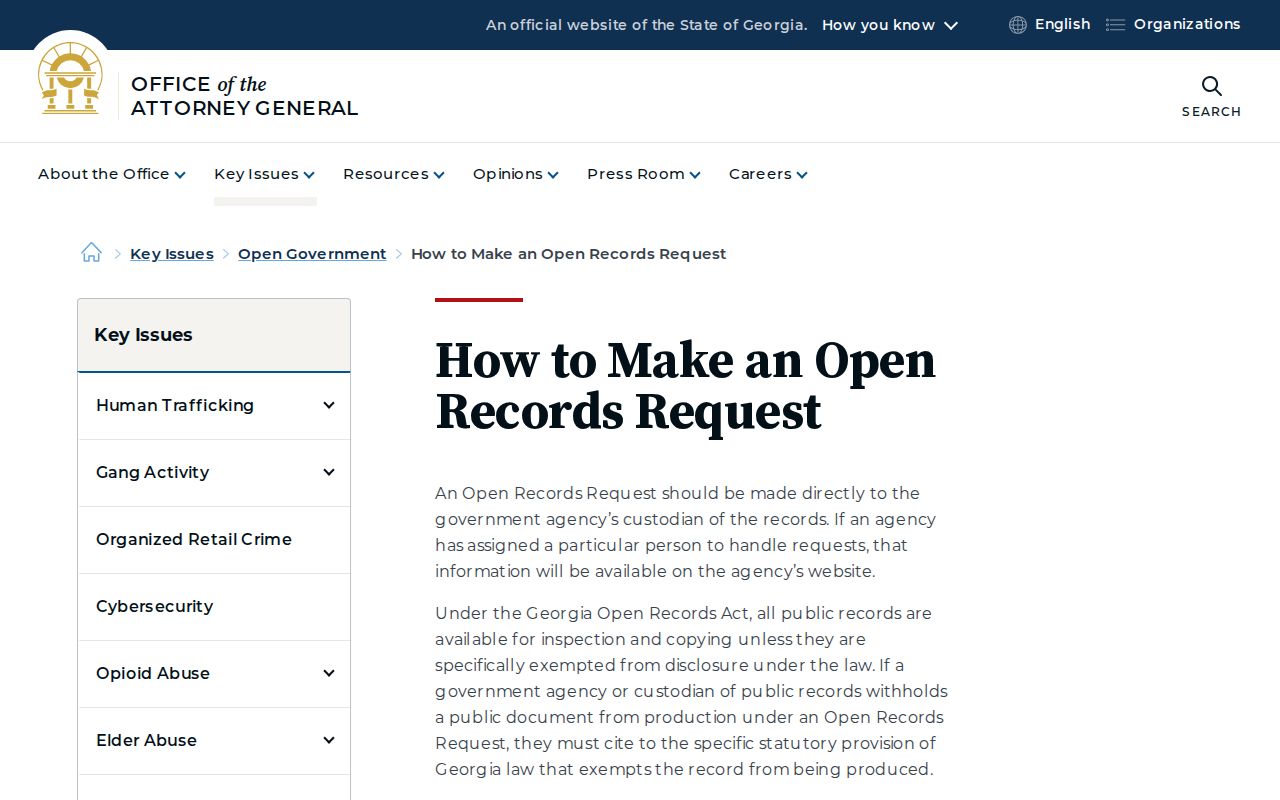
Georgia's Open Records Act opens a second route. It applies when a Clinch County public record is not available through the clerk's online provider, or when the request targets an administrative record. The Attorney General explains that an oral or written request may go to the custodian. Written works better for tracking. It should state the court or agency, the date range, the record category, your preferred format, and a way to reach you. It should also ask for an existing record rather than a new analysis. The Georgia Attorney General's Clinch request instructions and its request-form example supply the basic fields. The form does not route itself to Clinch County. Send it to the actual custodian, using the Superior clerk's published office address when that office holds the record. For a narrow case request, identify the case number or legal style. Add the filing year, the court class, and the document type. Get a fee estimate before authorizing any broad search. A solid request can read: "Please identify the custodian and access method for a Clinch County Superior Court case by the case number or case details supplied. I request the docket sheet and publicly available filed documents, subject to lawful redactions and sealing orders." The Clinch County clerk can then say where the item is searchable. It may sit in PeachCourt, in a local system, in paper storage, or with another court. Timing follows a general three-business-day response framework described in the Governor's Clinch request guidance. A Clinch County agency or clerk may provide access or explain when records will be produced. It may also give a lawful denial with an exemption. Search and redaction time can carry a charge under the statewide framework. None of that overrides a court sealing order or a confidentiality statute. Georgia's official open-records instructions lay out the basic shape of a focused public-record request.
Describe the Clinch County record you want, not just any record. A generic request is no substitute for naming the office that keeps the file.
Note: Clinch County posts no local online court-record request form and no local certified-copy form of its own.
Certified Copies and Fees
A plain copy just reproduces a Clinch County record for review. A certified copy is different. It carries the clerk's certification that the copy is true to the office's record. That holds whenever the clerk may issue one. Your purpose decides which one you need. Ask the Clinch County Superior clerk whether a docket printout, judgment, final disposition, transcript, or other document comes in certified form. One caution: a Clinch PeachCourt display or downloaded document is not certified. An official provider supplied it, but that alone changes nothing.
| Item | Amount or status | What to confirm |
|---|---|---|
| Clinch Superior plain copy | Local amount not posted | Ask the clerk about copy method, page count, and payment route. |
| Clinch Superior certified copy | Local amount not posted | Confirm which document can be certified and whether a separate certification charge applies. |
| Clinch County Open Records search or redaction | State framework applies | Request an estimate before a broad search or production. |
| Clinch County Open Records copies | Generally 10 cents per page or actual media cost | The statewide principle is not a Clinch County Superior certified-copy schedule. |
| Clinch County PeachCourt eAccess document | $2 per document plus $0.50 per page, with convenience charges described by the provider | Review the current PeachCourt terms before payment. |
Don't mix up fee schedules. Probate sets local charges for licenses and vital records, and those numbers say nothing about what a Superior Court certified copy costs in Clinch County. PeachCourt e-filing fees are their own thing too. They don't match the cost of pulling a document. Before you request anything, check the current PeachCourt fee guidance, the vendor's checkout terms, and the clerk's latest local schedule.
Want a sense of how statewide copy costs and advance estimates work? The Governor's open-records page spells that out for public records.
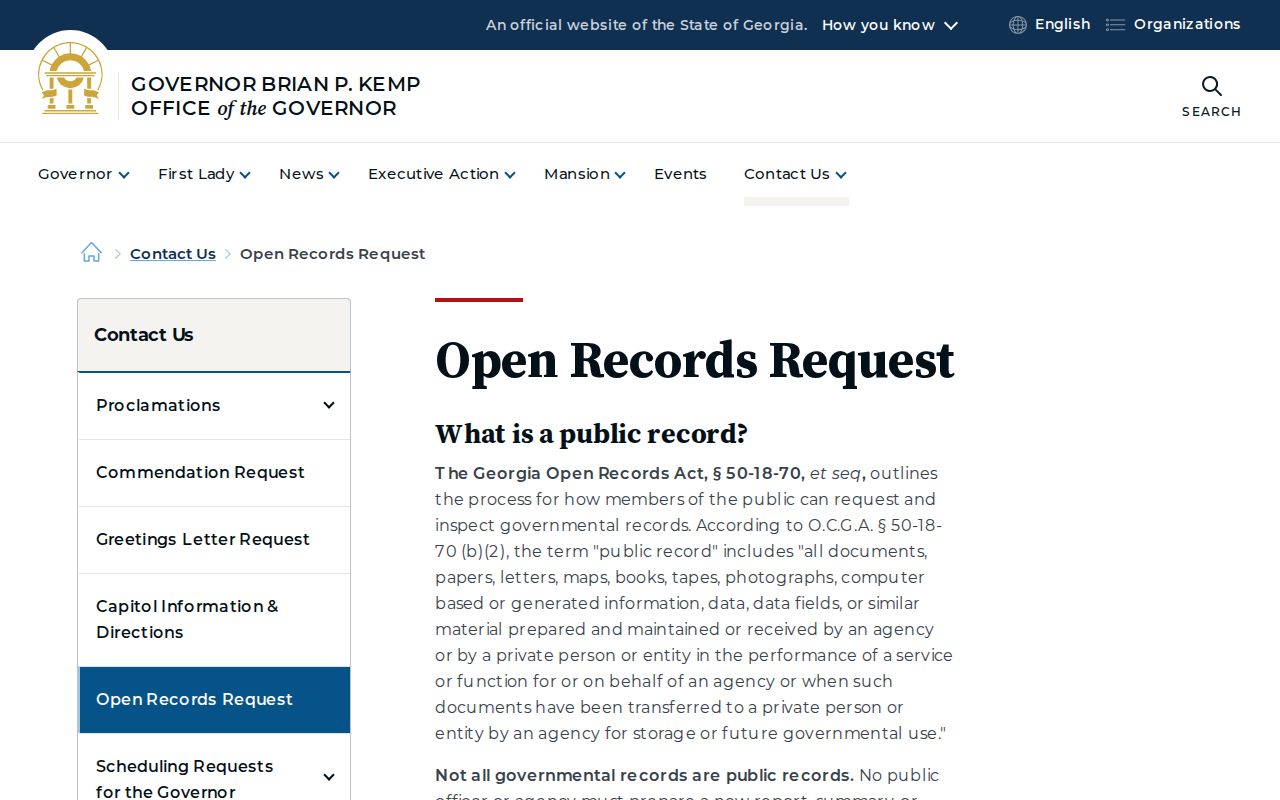
That state framework gives you a way to request a cost estimate. It cannot supply the missing Clinch certified-copy schedule. So call 912-487-5854 before you drive over or mail any payment.
Clinch County Record Request Boundaries
An Open Records request reaches records that already exist. It cannot break through a court sealing order. Juvenile confidentiality, adoption limits, and protected identifiers in a Clinch County file hold just as firm. Those barriers stay put no matter how the request is worded.
Restricting a criminal history through the GBI is a separate track. It does not edit a Superior Court docket. When you write to a Clinch County office, name the court, the date range, and the record type. State your access question plainly. Ask for what exists, not for staff to build a new analysis for you.
Clinch County Court Record Technology
Georgia treats electronic access and electronic filing as two different doors. The state E-Access directory points Clinch County Superior Court to PeachCourt. That vendor handles account-based case and document access. The state E-File directory names the same vendor for Clinch County Superior filings, and provider guidance sets mandatory civil e-filing as beginning July 1, 2018. A clerk-computer exception exists for some self-represented filers. Ordinary court fees and the listed filing exceptions still need current confirmation from the clerk. Confirm before you rely on them.
The technology path is therefore a chain: E-Access directory → Clinch County Superior provider link → PeachCourt account → county and court selection → exact case number or party search. PeachCourt help says many courts may have docket material reaching back to 2005, yet document availability varies. A Clinch County online result is not proof that every paper filing, exhibit, proposed order, historical minute book, or sealed item is present.
Tech has its limits in Clinch County. The public calendar runs on PDFs and links. It is not a searchable case-number index you can query from home. That still helps with access to court records. But a missing file, a record class question, certification, or an archive issue goes to the clerk. No portal replaces that office for the real answers about a court docket.
For state-level numbers, the Georgia Courts research and data source covers annual caseload collection and public data requests. It also lays out how data access differs from filing and records research.
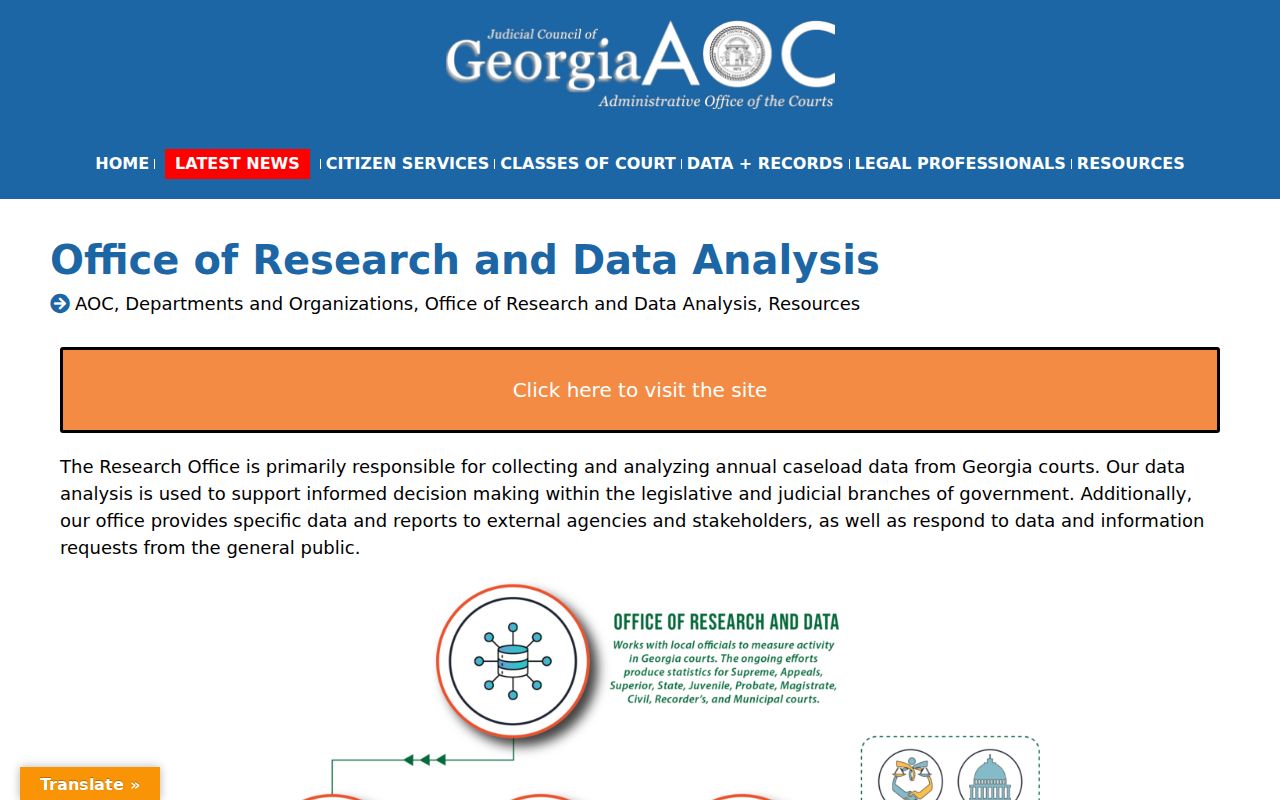
That statewide layer is only information. A Clinch County requester still has to pin down the right court and the right custodian for the record.
Note: PeachCourt’s general archive statement says material may reach back to 2005, but no official source guarantees that date for every Clinch County file.
Public Access and Sealed Records
Clinch County court records are open to the public. A statute or a court order can say otherwise. Open is not the same as unredacted, though. Uniform Superior Court Rule 21 builds the public-access and sealing framework. Rule 36.17 then pulls sensitive identifiers out of view. It covers Social Security numbers, financial-account numbers, and full birth dates, and it puts the redaction job on the filer. The redaction job falls on the filer. Rules 39.2 and 39.3 lay out the civil and criminal docket fields. Neither rule promises every document or every field to every requester who asks.
Key access rules:
Uniform Superior Court Rule 21 allows Clinch County public access while recognizing sealing, in-camera material, and limits imposed by law or order.
Rules 36.16 and 36.17 treat Clinch County electronic records as court records and require protection of specified personal identifiers.
Rules 39.2, 39.3, and 39.6 support Clinch County civil and criminal docket fields while preserving adoption and other protected-record limits.
O.C.G.A. §§50-18-70 et seq. governs the Clinch County Open Records Act route, subject to court-specific confidentiality laws and orders.
O.C.G.A. §§15-11-708 and 15-11-709 limit public inspection of Clinch County juvenile records. Adoption, DFCS, medical, guardianship, and involuntary-hospitalization material may require an additional access review.
Criminal-history restriction under O.C.G.A. §35-3-37 runs on its own track. The Georgia Bureau of Investigation explains that process. Do not treat it as automatic destruction of every clerk record. It is not. When a Clinch County provider or clerk shows nothing for an item, several neutral reasons could explain it. The record may be sealed, restricted, not digitized, unavailable through that provider, or held by another custodian. Ask the clerk for the lawful route instead of guessing.
Clinch County Court Record Rules
Electronic access to Clinch County court records keeps shifting. The Georgia Supreme Court amendments page now records a new Uniform Superior Court Rule 36.19, effective February 26, 2026, covering digital takedown. The date is documented. But the rule's title alone cannot tell you that a particular Clinch County record will be removed, corrected, or suppressed. Read the current rule and ask the responsible clerk or court which procedure applies.
The same caution covers provider terms, e-filing exceptions, calendar links, and document availability in Clinch County. A page that once handed you a form or file may later demand an account, a fee, a redaction, or a direct clerk request. The safest sequence never changes. Court class comes first, then custodian, record type, and access method. Finish with a current fee or privacy check.
Georgia's official rule-amendment source is where you confirm any current Clinch County effective date.
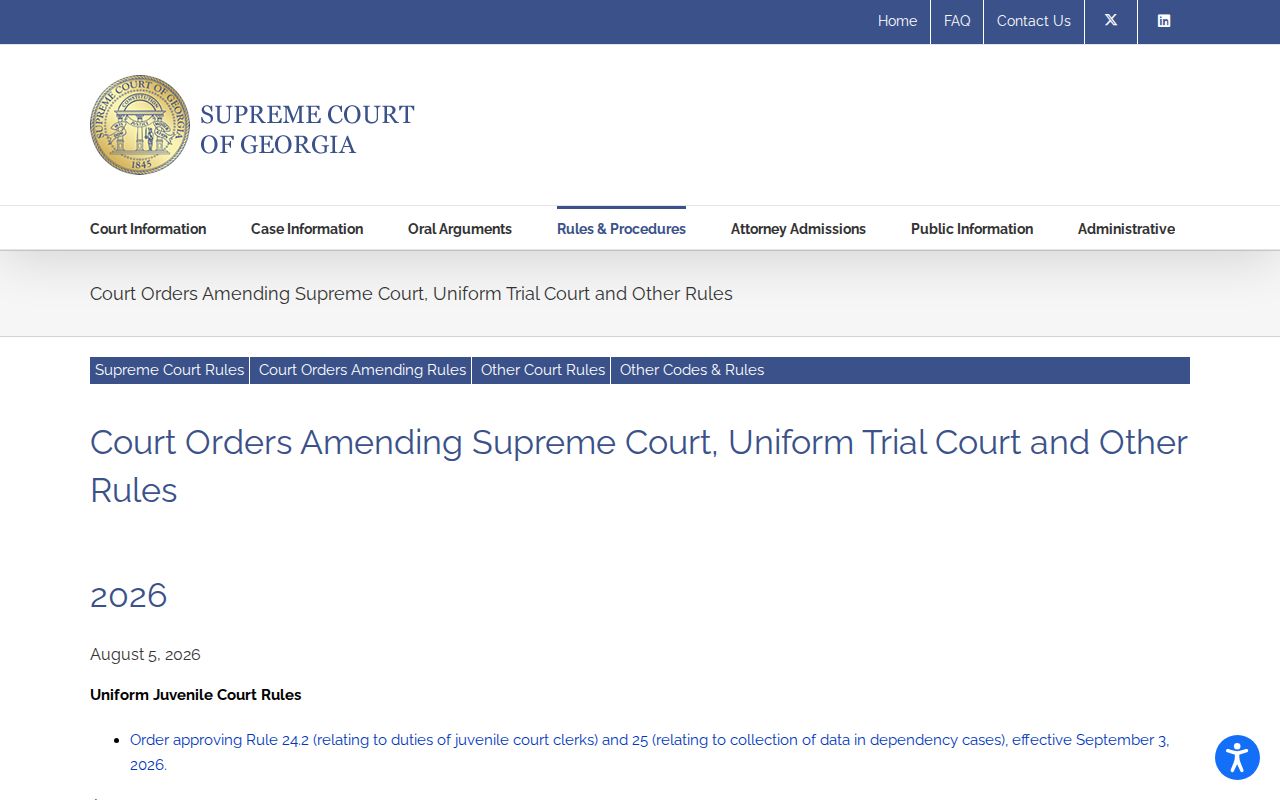
Verify the rule in force before you act. Any Clinch County request touching digital access, privacy, or a record that has vanished from a provider display turns on the version of the rule then in effect.