
How to Search Civil Dockets
The state's own entry point is the Georgia Courts E-Access directory. It names Clinch Superior and points the public to PeachCourt. That provider sits behind an account. You register or sign in before any Clinch County search opens. Its help pages describe three ways in: pick Clinch County and the court, type an exact case number, or search by party name. There is no open text box for casual lookups.
Know the court class before you type a name. A divorce, annulment, adoption, name change, or garnishment in Superior Court travels a different route than a Magistrate small claim or a Probate estate. When a Clinch County record does not appear, the Superior Clerk can help. The clerk can tell you whether it is local, archived, protected, or held by another office.
- Open Georgia Courts E-Access and select Clinch Superior from the provider directory.
- Sign in to PeachCourt or create the account required before the court-search screen.
- Choose Clinch County and the court, then search with the exact case number or a party name supported by the provider.
- Compare the result with the action type, filing date, parties, attorneys, and docket entries.
- Ask the Clinch County Clerk of Superior Court for a plain copy, certified copy, judgment, or file-inspection route when the online result is incomplete.
Two PeachCourt functions often get confused. Searching a Clinch County case locates the action and its docket entries. E-filing and clerk requests are the separate step that identifies a specific document and its access terms. Keep the two straight and each task goes faster.
Clinch Civil E-Filing Since July 2018
Georgia Courts lists Clinch Superior as a PeachCourt e-filing court. Per PeachCourt's mandatory-filing guidance, mandatory civil e-filing began July 1, 2018. That date changed the Clinch Court filing workflow. It does not promise that older paper filings or historical civil documents are online.
The guidance also records a clerk-computer exception carrying a $0 e-filing fee. Ordinary Clinch court fees still apply. Pauper affidavits, bond validation, temporary protective orders, and ex parte or in-camera matters appear on the exception list. Confirm current provider instructions and ask the clerk before counting on any exception. PeachCourt's first-time e-filing guide walks through filing, not public docket searching.
The Georgia Courts e-file directory names PeachCourt for Clinch Superior. Its role becomes clearer once you separate it from the account-gated public search. The provider's attorney-of-record document-access guidance opens one route for e-filed documents. It does not make public access unrestricted.
| Filing point | What the research supports | What still needs confirmation |
|---|---|---|
| Mandatory civil e-filing | Clinch Superior was listed as mandatory beginning July 1, 2018. | Current exception list and current checkout amounts |
| Clerk computer | A Clinch clerk-computer exception is described with a $0 e-filing fee. | Availability, hours, and ordinary court fees |
| Protected filing | Pauper, bond, temporary-protective-order, ex parte, and in-camera items are listed exceptions. | Whether a particular filing qualifies |
The Clinch e-filing history explains a common puzzle: why a civil docket holds electronic entries yet no complete digital case file. The directory is the place to trace that shift.
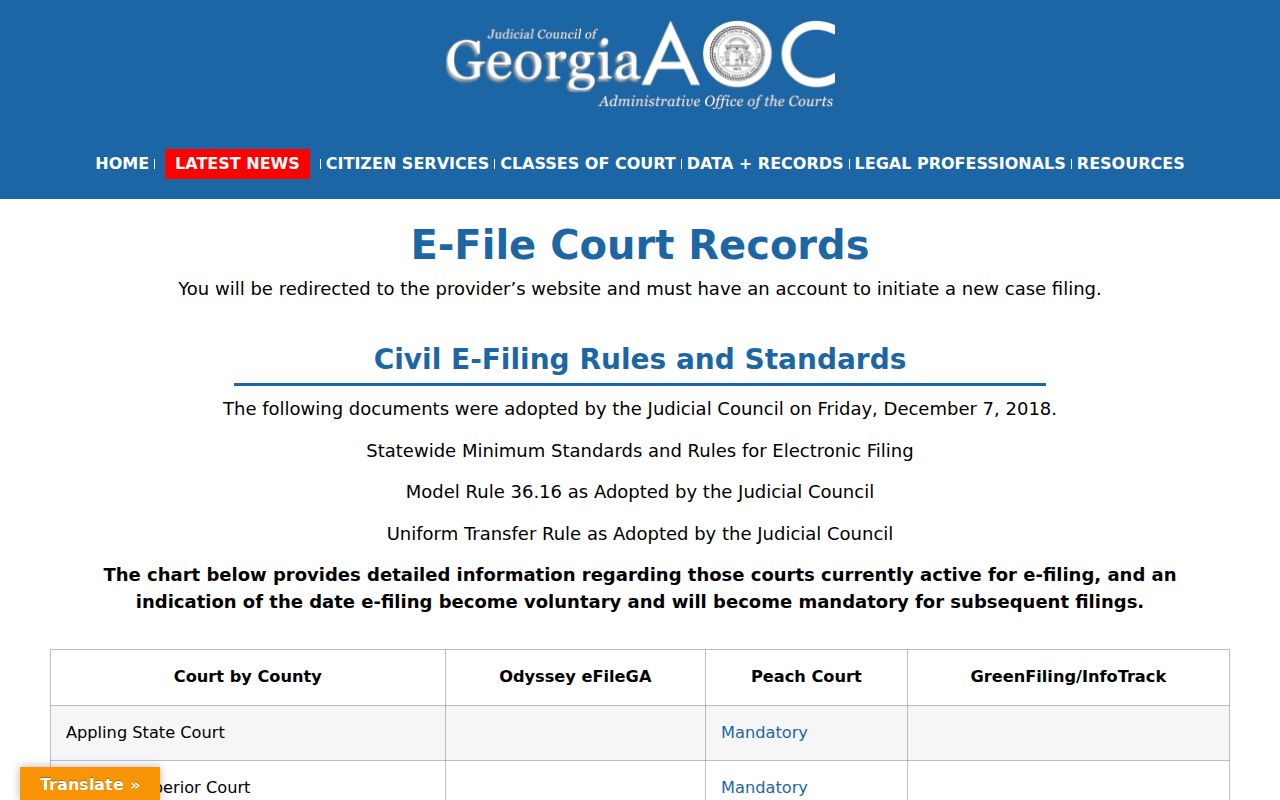
Treat the e-file directory as confirmation of Clinch Superior's provider, nothing more. It names the vendor. It cannot replace the local civil docket or the clerk's office.
What a Civil Docket Shows
Uniform Superior Court Rule 39.2 supplies the model a Clinch County civil docket follows. It is worth knowing when you make a precise request. The rule-based fields cover the action number, cause or action type, attorneys, parties, filing date, service, costs, disposition, judgment type, trial details, and final-record references. The field list below is a model drawn from the rule. It is not a sample person's record.
Each docket line also has limits. A filing date records when material entered the case. A service date with its method shows how process reached a party. A disposition and judgment entry reflect later results. None of these lines is the pleading or exhibit itself. Keep those distinctions when asking the Clinch County clerk for a particular document.
| Action number | The civil case identifier assigned by the court, shown as the exact Clinch action number. Use the exact number supplied by PeachCourt or the clerk. |
|---|---|
| Cause and parties | The Clinch County action type, plaintiff and defendant or other parties, and the attorneys shown in the docket. |
| Filing and service | Clinch County filing date, service date, service method, and the required initiation or pauper-affidavit information. |
| Costs | Advance or additional costs and related civil docket entries. An online field in a Clinch County display is not automatically an invoice. |
| Disposition | The Clinch County disposition may be a dismissal with or without prejudice, settlement, judgment, mistrial, or another recorded result. |
| Judgment and appeal | Clinch judgment type, prevailing party, Fi.Fa. date, minutes or final record, pleadings, motions, transcript, appeal, and remittitur references. |
Clinch County Civil Docket Number Clues
Rule 36.9 sketches the civil case-ID model: filing year, case type, consecutive number, and judge assignment when required. No official source publishes a concrete Clinch County example. Treat the model as a clue for requests rather than a number to copy. Ask PeachCourt or the Clinch County Clerk of Superior Court for the exact action number, and keep its punctuation intact.
One more caution. A Clinch County action number is not a PeachCourt filing number, a citation number, or a document-control reference. When requesting a docket sheet, judgment, service entry, or certified copy, give the clerk the party style and filing year along with the number.
year / civil case type / consecutive number / judge assignment, when required
Clinch Civil Service and Judgment Fields
The most useful Clinch County civil docket details are easy to overlook. They look nothing like a final result. A service entry tells you when and how process was delivered. A pauper affidavit can stand in for the civil filing fee where the court accepts it. A case disposition form accompanies a judgment, settlement, dismissal, or similar resolution. A Fi.Fa. date points to enforcement of a money judgment, not the filing of the original complaint.
- Service
- The Clinch County docketed date and method of formal delivery of process.
- Pauper affidavit
- An indigency filing used in place of a civil filing fee where the court accepts it.
- Fi.Fa.
- Fieri facias, an enforcement-related writ connected to a money judgment.
- Remittitur
- An appellate return or order that may appear after an appeal.
Rule 39.2 also calls for a summary of pleadings, dates, transcripts, new-trial motions, appeals, and remittitur. A Clinch provider display may still leave some of that out. When an item is missing, name the exact document. Ask whether it is sealed, undigitized, in paper storage, or held elsewhere. The Georgia Supreme Court's official page offers appellate context, but it is no substitute for the local civil docket.
Types of Civil Cases on the Docket
Clinch County civil filings span several categories. The Clerk of Superior Court page lists them by name. Superior Court also holds broad civil jurisdiction along with domestic-relations matters. Because a civil-sounding record may actually sit in Probate or Magistrate, read any Clinch County docket alongside its court class before assuming where it lives.
- Clinch County divorces and annulments filed in Superior Court.
- Clinch County adoption and name-change filings, with adoption records subject to special confidentiality rules.
- Clinch County garnishments and other Superior civil actions identified by the Clerk of Superior Court.
- Clinch County domestic-relations matters, including child-support settings shown on circuit calendars.
- Magistrate small claims under $15,000 and dispossessory matters.
- Probate estates, wills, guardianships, and related Probate services held by that separate office.
A case type on a Clinch County docket is a routing clue. It is not a promise that the document itself is public online. Adoption, child-welfare, medical, financial, and similar protected material often carries narrower access than the docket metadata that points to it.
Clinch Magistrate and Probate Civil Routes
The Clinch Probate and Magistrate page lists each office's contacts and services separately. Magistrate Court takes small claims under $15,000 plus dispossessory writs. Probate handles wills, estates, guardianships, involuntary hospitalization files, licenses, and vital records. Neither office can be assumed to follow the Superior PeachCourt workflow. For statewide Probate context, the Georgia Council of Probate Court Judges is the reference. But it offers no Clinch Superior case search. Clinch County posts no public Magistrate search form. There is no case-number database, local filing-fee schedule, or certified-copy schedule either. The Probate page does publish service fees. Those are not Superior Court copy fees or Magistrate filing fees, so keep them separate.
| Office | Use it for | Published contact |
|---|---|---|
| Magistrate Court | Small claims, dispossessory matters, warrants, and other limited functions | 110 Court Square, 912-487-2514 |
| Probate Court | Estates, wills, guardianships, licenses, and vital-record services | 110 Court Square, 912-487-5523 |
| Superior Clerk | Superior civil and domestic dockets, filings, and final records | 25 Court Square, Suite C, 912-487-5854 |
Clinch County Probate service fees run as follows. A weapons-carry license costs $72. A renewal costs $30. Marriage licenses run $76, or $36 with counseling. Vital records cost $25 for the first copy and $5 for each additional copy. All of these amounts belong to Probate services, so do not carry them over to a Clinch County Superior civil docket request.
Settings and Hearings on Civil Dockets
The Clinch Alapaha Judicial Circuit posts Clinch County civil settings through several links. Those cover monthly, annual, weekly, calendar-call, and civil-trial calendars. The August 2026 specimen lists Clinch Civil CC & Hearings. It also lists Child Support, Trial Calendar DUE, and Trial Notices. What the public calendar leaves out matters. No party name, action number, judge, room, or result appears. It can narrow a date search without proving what happened in court. When a civil date truly matters, check the current circuit posting. Then ask the Clinch County Clerk of Superior Court to confirm the case-specific entry. Remember that a calendar call, trial-calendar deadline, hearing, reset, or notice is not automatically a judgment. The full date-reading route is laid out in the Clinch County court calendar. Clinch domestic-relations resources include an uncontested-divorce packet. They also include a standing-order resource for cases filed after March 15, 2024. Those materials help with procedure. They do not work as a public case search.
Clinch County Civil Filing Archive
Mandatory Clinch Superior civil e-filing began July 1, 2018. That date does not mark the start of the Clinch County online archive. PeachCourt help says many courts may have docket material reaching back to 2005. Clinch's exact digital start date is unclear. Earlier paper filings, exhibits, and minute-book material may still require a trip to the Clinch County clerk. Some filings listed in the e-filing guidance carry protection. Pauper affidavits, bond validation, temporary protective orders, and ex parte or in-camera matters may follow an exception. They may also follow a special access route. A blank provider result deserves a check with the Clinch County clerk. Never treat it as proof that no Clinch County civil case exists.
Clinch County Civil Clerk Requests
When a Clinch County civil result comes up missing or thin, the Clerk of Superior Court is the local starting point for a Superior action. Give the action number if known. Add the filing year, case type, party style, and the exact item sought. Ask where the record sits: PeachCourt, a local system, paper storage, or a restricted-access rule. Keep a request for docket inspection separate from a request for a plain copy, certified copy, judgment, transcript, or filed pleading. Clinch County publishes no public civil search form and no local certified-copy fee table. A written request under Georgia's Open Records framework can document an administrative records request. It cannot override a civil sealing order. Nor can it force the Clinch County clerk to create a new case analysis.
Clinch County Civil Workload Is Circuit-Wide
Workload figures only help when the unit and geography stay visible. The 2025 Superior Court Workload Assessment reports three-year Alapaha Judicial Circuit averages. Those averages cover 506 general civil cases. They also cover 832 domestic-relations cases and 1,338 total civil cases. The five-county circuit is the unit, not Clinch County alone.
The 2024 report covered the whole circuit. It showed 501 general civil and 880 domestic-relations cases. The civil total came to 1,382. Be careful mixing counts. A docket line, a complaint count, and a provider document count are not interchangeable. Georgia's data office defines units differently across civil, criminal, and traffic systems. The official workload assessment is useful for circuit context. It is not evidence of a current Clinch-only caseload or a local backlog.
Public Access to Civil Dockets
Openness is the default in Georgia court records. Uniform Superior Court Rule 21 presumes public access to civil dockets. A statute or court order must say otherwise. Rule 36.17 then pulls back the most sensitive identifiers. These include Social Security and tax numbers, financial-account details, and full birth dates. So the public version of a Clinch County civil docket can show less. It may lack items in the full case file held by the clerk. An online provider may trim it further still.
Some records sit off limits entirely. Clinch County adoption records stay sealed or confidential unless a judge grants access. Domestic cases often carry protected attachments too. Those can cover finances, children, or medical matters. Georgia's Open Records Act, O.C.G.A. §§50-18-70 et seq., gives the public a request route directed at the record holder. That law still bends to a sealing order. It also bends to a specific confidentiality rule from the court.
Access rules to keep with a civil request:
Uniform Superior Court Rule 21 describes Clinch public court records and the process for limiting access by law or order.
Uniform Superior Court Rule 36.17 sets the permitted treatment of sensitive identifiers in public filings.
O.C.G.A. §§50-18-70 et seq. direct an Open Records request to the actual custodian and preserve lawful exemptions.
Clinch Civil Copy Fees and Archive Gaps
The Clinch County Superior Clerk posts no certified-copy fee schedule. There is no local civil-copy order form either. So get a quote from the clerk before you pay anything. Skip the shortcuts that look tempting. The Probate service-fee list is the wrong price for a Clinch County court docket copy. So is another Georgia county's tariff. So is a PeachCourt checkout total. When you call, say exactly what you want: inspection, an uncertified copy, a certified copy, a transcript, or a filed document.
How far back can you search online? PeachCourt help says dockets at many courts may reach back to 2005. Availability varies by court and by document. Clinch County's exact online archive start is not fixed anywhere. That leaves a good deal on paper. Exhibits, proposed orders, sealed items, older minute books, and other physical filings may still need a clerk or archive request in Clinch County.
If a civil record turns up missing, hand the clerk's office the court class and the action number if you have it. Add the filing year, the parties, the record type, and how you want it delivered. The Georgia Attorney General's request form lays out those same basic fields. Filing it out does not route your request to Clinch County, so you still have to send it yourself.
Get a fee estimate before you authorize any large search. Georgia's Open Records framework permits documented search, redaction, copying, and media costs under its rules. The Clinch County Superior Clerk remains the source for a court-specific certified-copy price.