
Searching Cases by Name
For a name search in Clinch Superior, pick the county and court in PeachCourt first. Then run the party name. Use the full legal name. Match any result against the filing year, the case type, the attorneys, and the court. Similar names often show up more than once. A name match alone does not prove the record belongs to the person you have in mind.
Before you search, settle which court the Clinch matter belongs in: Superior, Probate, Magistrate, Juvenile, a municipal court, or the federal system. Run a name in the wrong court and the case looks missing even when it exists. The Georgia Courts E-Access directory is only a provider list. Its Clinch Superior link will not reach Probate estates, Magistrate small claims, city citations, or protected Juvenile files.
- Open the official Georgia Courts E-Access directory and select Clinch Superior for a Superior matter.
- Sign in to PeachCourt or complete its account registration, then choose the Clinch county and court in the Cases path.
- Enter the Clinch party name without assuming that a partial match identifies the right case.
- Check the Clinch filing year, case type, counsel, court, and case number against the result.
- Save the result details and ask the Clinch clerk about a docket, disposition, document, or certified copy when needed.
Clinch County Case Search in PeachCourt
PeachCourt handles e-filing and documents for Clinch Superior, but having a provider account is not the same as open access to every court record. Access is not automatic. The access page asks for an email and a password. Registration sits alongside it. So does a forgotten-password option. No live Clinch case list appears before sign-in.
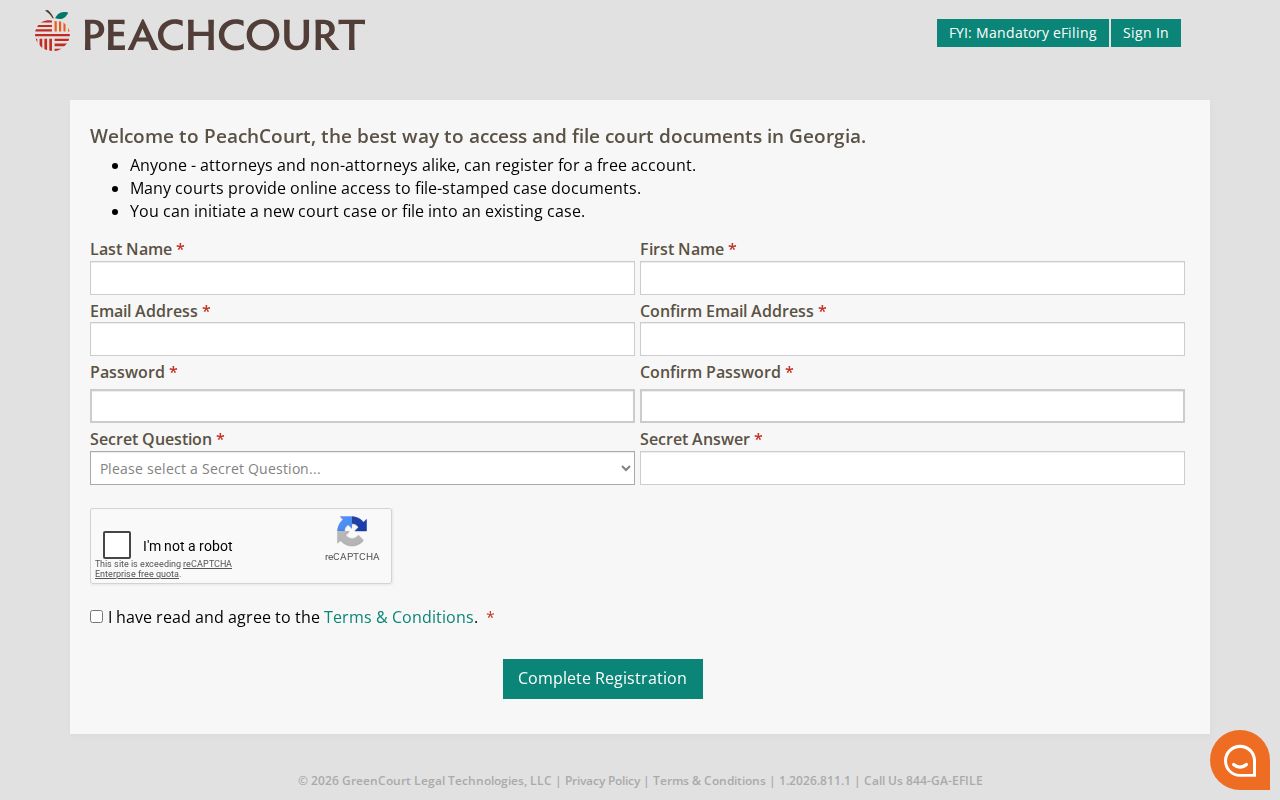
The registration screen wants a last name, first name, email and confirmation, password and confirmation, a secret question and answer, reCAPTCHA, and a Terms and Conditions checkbox. Clinch provider's search help says to choose the county and court. Then search by exact case number or party name. A separate filing search can also use a Peach number. These are provider workflows, not a promise that every old paper file is online. The official account gate is visible before a Clinch search can begin. That gate is exactly why a public search plan needs a clerk fallback.
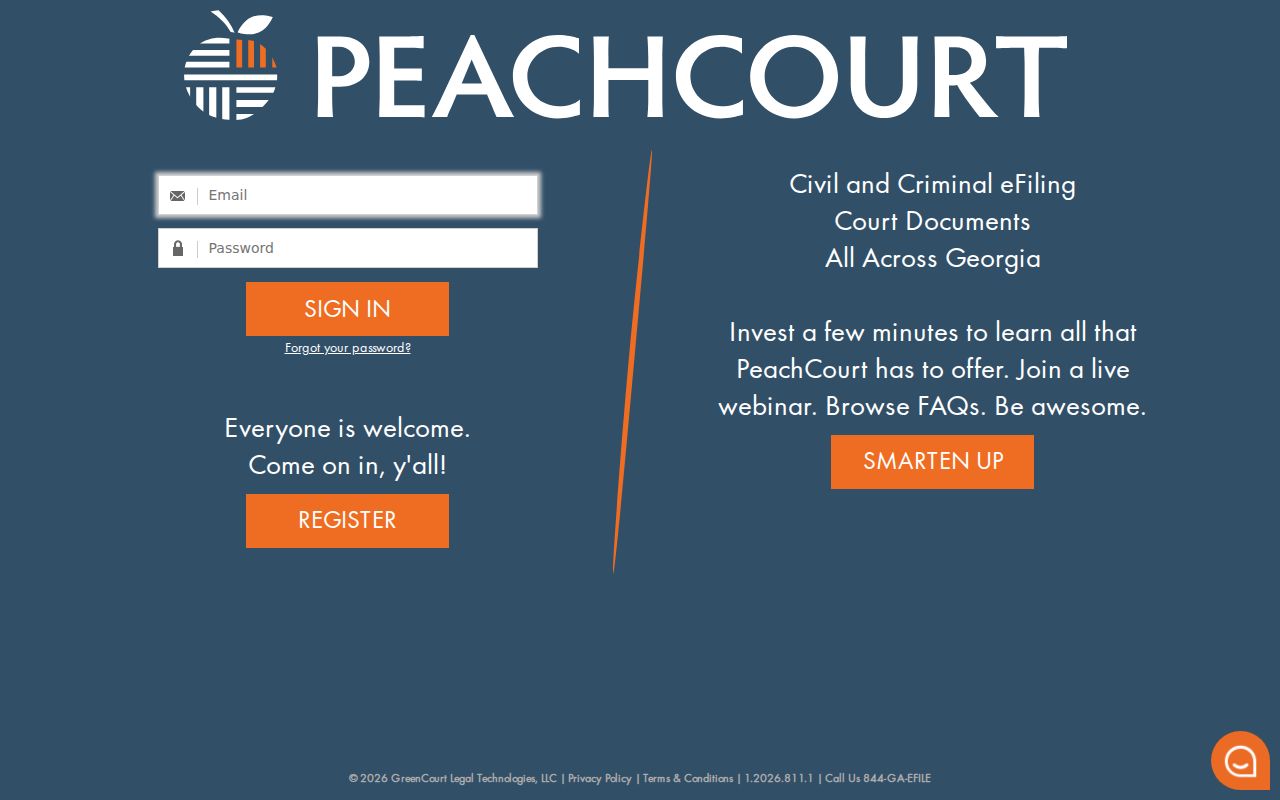
This screen is an access gate, not a sample Clinch docket, and no private person's case appears in it. Clinch registration is a separate step from finding a case. Read the provider's fields as account requirements rather than fields in the court's own docket.
Once you are in, the provider decides which Clinch case and document fields you can see. The Clinch County Clerk of Superior Court still holds the official record and sets the lawful access limits.
Searching by Case Number
An exact case number is the surest way to cut through duplicate names in a Clinch search. PeachCourt help says the number must match its exact format. If you do not know it, ask the Clinch clerk or the provider. Keep the punctuation and spacing unchanged afterward. Never stretch a truncated result into a guessed case number.
Georgia Rule 36.9 lays out a civil case-ID model. It can combine the filing year, case type, consecutive number, and judge assignment where required. No official Clinch source publishes a concrete local example. So treat the model below as a rule-based clue. It is not a real person's case number.
year / case type / consecutive number / judge assignment, when required
Clinch criminal docket rules separately call for a unique case number plus filing date, charging instrument, counts, citation number where relevant, plea, disposition, sentence, and appeal entries. The clerk can tell you which number belongs to the Superior case. A Magistrate file, a city citation, or another Clinch court class each has its own.
Clinch County Case Search Filing Trail
Clinch Superior civil cases moved to mandatory e-filing on July 1, 2018. A clerk-computer exception and other listed exceptions apply. That date helps narrow a search. It does not tell you that older paper filings were scanned, or that newer ones are publicly viewable. Ask which path the matter took. Did it go through the PeachCourt filing path, or does it still sit in a Clinch clerk-held paper or local record?
Clinch e-file charges stand apart from any document-access or convenience fee. A search result may point to a filing yet say nothing about whether a copy is free, purchasable, certified, sealed, or available from the Clinch County Clerk of Superior Court.
Clinch County Case Search Court Routes
A Clinch County case search only pays off once you know the court. Superior Court takes broad civil matters and felony cases. Probate covers estates, wills, guardianships, licenses, and listed vital-record services. Magistrate handles small claims under $15,000, dispossessory actions, warrants, and preliminary hearings. Juvenile records are access-controlled. City courts take city traffic and ordinance matters. Federal cases live in PACER and the Middle District of Georgia, Valdosta Division. The statewide court-navigation guide explains court roles generally. It is not a Clinch case index.
| Record class | First route | Search limit |
|---|---|---|
| Clinch Superior civil or criminal | Georgia E-Access, then PeachCourt | Account gate; document availability varies |
| Probate estate or license | Clinch Probate office | No public county case-search form located |
| Magistrate claim or dispossessory | Clinch Magistrate office | Separate custodian; no public search form located |
| Juvenile matter | Juvenile Court clerk | Public-name search is restricted |
| City citation or ordinance matter | Issuing city court or city clerk | Clinch routes differ by Homerville, Fargo, Argyle, and Du Pont |
| Federal matter | PACER, CM/ECF, or Valdosta clerk | Separate federal account and fee rules |
Clinch County Case Search Status Terms
Clinch County search results make far more sense once you speak the docket's language. The court's own terms mark each stage of a criminal file. OBTS tags the offender-based tracking entry. An indictment or accusation names the charging instrument. A disposition line records how a case or count ended. Two more terms matter. Nolle prosequi signals that the prosecution dropped the matter. A remittitur marks an appellate case sent back down to the lower court.
- Fi. Fa.
- A Clinch writ or record associated with a money judgment and collection process.
- Disposition
- The recorded outcome of a case or individual count.
- Remittitur
- The appellate court's return of jurisdiction or record to the lower court.
- OBTS
- An offender-based tracking identifier used in criminal-record reporting.
These terms help you spot the right entry in a Clinch County docket, but they have limits. A search result is not a certified judgment. Nor is it a full criminal-history report. For the official answer, ask the Clinch County Clerk of Superior Court which docket entry or filed document actually supplies it.
What a Case Search Returns
A Clinch search hit can tell you a good deal. It may list the case number, court, parties, and filing date. Docket entries and documents the provider carries may appear too. What it cannot do is certify itself. No result arrives as a certified copy. It also cannot prove a current setting or reveal material sealed or redacted away. Does a complaint, indictment, judgment, dismissal, plea, sentence, or appeal need interpretation? The official Clinch docket's dated entry controls. Calendar questions run through a separate source. The Clinch circuit posts a public PDF calendar, and it may show only a Clinch prefix with a setting label. No case number, party, judge, attorney, room, result, or live status comes with it. To trace the full filing history, the Clinch County court-records route explains how to ask for the document sitting behind a docket line.
| Case identity | Case number, court, case type, filing date, parties, and attorneys when public. |
|---|---|
| Docket activity | Filed pleadings, service, motions, orders, hearings, judgments, dispositions, sentences, or appeals. |
| Access status | Available, redacted, sealed, unavailable through the provider, or held by another custodian. |
| Document result | A provider link or purchase option when a document is available; not automatically a certified copy. |
| Calendar relation | A setting may be a lead for clerk confirmation, not proof of appearance or outcome. |
Clinch County Case Search Result Fields
Want a clerk request that lands right the first time? Model it on the field lists in Uniform Superior Court Rules 39.2 and 39.3. For a Clinch civil file, those fields cover the action number, action type, parties, lawyers, filing and service, costs, disposition, judgment type, trial, prevailing party, Fi. Fa., minutes, final record, and appeal. A Clinch criminal request can reach the unique number, charging instrument, counts, plea, count-by-count disposition, sentence, costs, fines, restitution, warrant returns, transcript, appeal, and remittitur. Remember what these inventories are. They are rule-based checklists, not live Clinch records. If a field comes back empty, do not panic. The item may be restricted, undigitized, off the provider, or housed in a different court. Ask the custodian for that exact category. Requesting a brand-new case summary is not the clerk's job. The provider's official court-search destination is open to the public. That is where a Clinch County case search begins. It is an entry gate, not a live result screen.
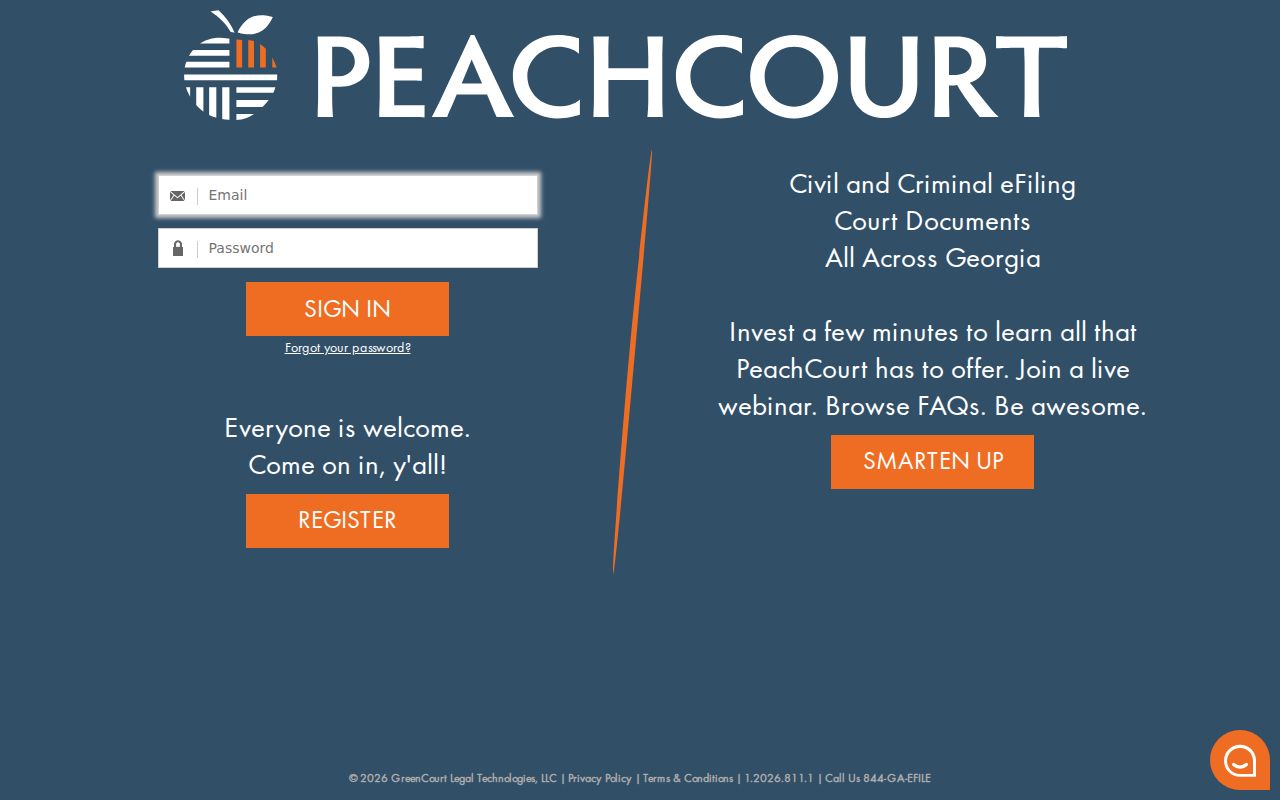
The gate itself is the lesson: a search interface is one thing, and the official court record the clerk holds is another.
Statewide vs County Case Search
Georgia Courts E-Access feels statewide. In a way it is. It lists providers for courts across Georgia rather than merging them into one database. Pick Clinch Superior there. The directory hands you to PeachCourt. Meantime, the Clinch County clerk page posts no free-text case search of its own. So the design is provider plus clerk, never one search field spanning every court class.
| Route | Useful for | What it does not promise |
|---|---|---|
| Georgia Courts E-Access | Finding the named provider for a court | A single statewide case index or free-text search |
| PeachCourt | Clinch Superior case and document workflow after account access | Every paper, historical, sealed, or restricted document |
| Clerk of Superior Court | Index help, paper files, copies, dispositions, and custodian direction | Instant retrieval or a posted local fee table |
| Alapaha public calendar | Clinch County/date/setting leads | Party names, case numbers, results, or universal coverage |
Clinch County Case Search Fallbacks
When the Clinch online search fails, go narrow. Give the court class and the approximate filing year. Add the case type, the legal party style, and any setting date you know. Ask the Clerk of Superior Court where the item lives: PeachCourt, a local system, or paper and archive storage. Keep requests separate too. A docket-sheet ask is not a certified copy request. The same goes for a judgment, a sentence, a transcript, or the full document set. The Georgia Open Records Act gives Clinch County requesters another lever. It permits an oral or written request to the custodian for public records, and the Georgia Attorney General spells out the response, exemption, search, and copy rules. Put yours in writing when you can. A written request is simply easier to track. Identify the record and its date range, and do not ask the office to build a new analysis. The act yields to a sealing order or any court-specific confidentiality rule. Chasing a Clinch court date? Check the current Clinch Alapaha posting first, whether monthly, annual, weekly, calendar-call, or civil-trial. Then call the Clinch County clerk. One caution: a miss in a public calendar does not prove the case is absent. For a federal matter, skip the state route entirely and use PACER or the Middle District Valdosta clerk.
Clinch County Case Search Provider Limits
PeachCourt's Clinch guidance is blunt about limits. Document availability varies by court and by document, it says. Its help materials add that many courts may hold docket material back to 2005, though no official source pins down Clinch's exact online archive start date. Expect sealed, adoption, and unexecuted proposed orders to stay out of the provider's purchase flow. So a blank result can mean several things. The account gate blocked you. The document is not online, the category is protected, the file sits in paper, or another custodian holds it. Read the PeachCourt document-access guidance alongside the local instructions from the Clinch County Clerk of Superior Court. Do that before calling any search complete.
Access and Restricted Cases
Some Clinch County court records carry limits set by law or by court order. Rule 21 lets a judge seal a defined part of a case file. Rule 36.17 shields sensitive identifiers from view. O.C.G.A. §§15-11-708 and 15-11-709 govern juvenile records. Adoption files, in-camera material, and certain child-welfare, medical, guardianship, or involuntary-hospitalization records can face extra restrictions too. So a blank result from a Clinch provider tells you nothing about which limit applies.
Keep your language neutral when a Clinch docket search shows no case. The file may be sealed or restricted. It may simply not be digitized, or the provider may not carry it. Another office may hold it. The Clinch County clerk can explain the lawful access route. Never copy protected identifiers from any record. That means Social Security numbers, full birth dates, financial-account numbers, juvenile identities, and the rest.
Clinch County Case Search Boundaries
Start with what the state's analytics tools actually do. The Criminal Case Data Exchange dashboard is official. You can filter it by Clinch County or by court class. It refreshes on a 60-day cycle. But it counts disposition transmissions by OTN, so it is not a public name search. The juvenile side is different. That system posts a confidentiality notice and sits behind an authorized-access gate. Neither tool substitutes for the case file held by the Clinch Superior clerk, which remains the record of authority for a Clinch County court docket.
Federal matters add another layer. Clinch federal cases run through the Middle District of Georgia, Valdosta Division. They sit on the PACER or CM/ECF system. The Alapaha Drug and Mental Health Court directory lists a circuit program serving Clinch, though it offers no separate public specialty-court docket search. Before treating any Clinch result as a case record, match it to the right court class and the right office. A docket search only counts when it lands in the correct hands.